Key View

The AI story lives on – but cheap money is history

Key View for the fourth quarter of 2026

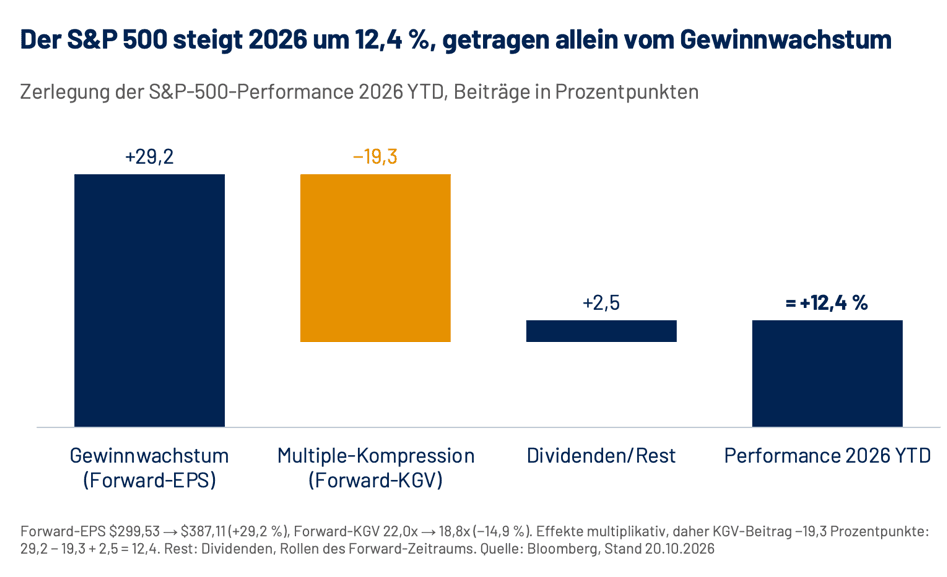
  • The rally in the US equity market continues to be driven by exceptionally strong earnings momentum. Despite double-digit price gains, valuations have actually fallen since the start of the year. There can therefore currently be no talk of an AI bubble.
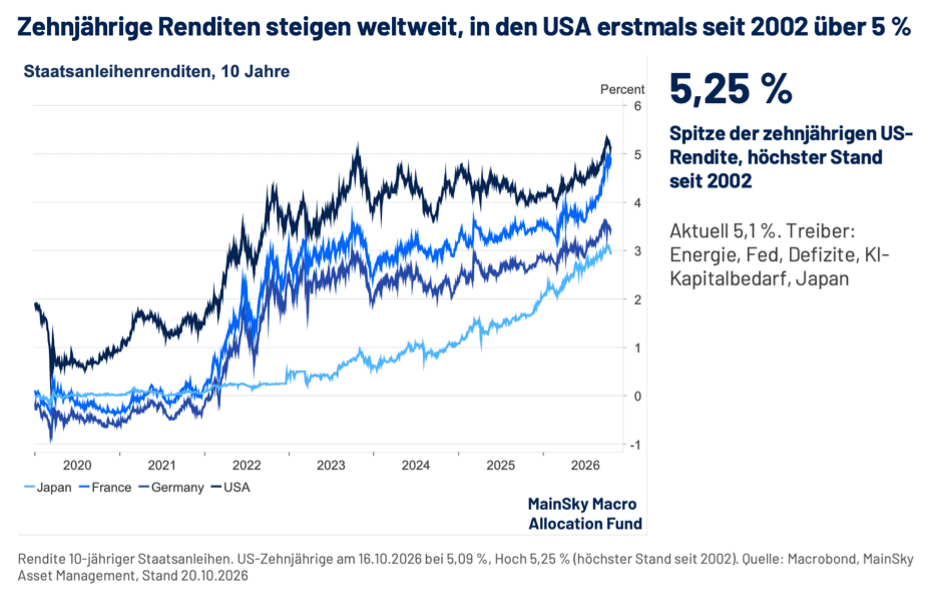
  • The global rise in yields is not merely an expression of more restrictive monetary policy, but also a consequence of high government deficits and increasing competition for capital. Companies with high financing needs in particular are coming under pressure.
  • France is becoming the largest fiscal risk in the eurozone. Without a fundamental change of course, it faces debt dynamics that are likely to require intervention by the ECB in the medium term.
  • We are maintaining our positive assessment of equities, but are focusing more consistently on quality, solid balance sheets, free cash flow and AI beneficiaries with viable business models. European equities remain underweight.
  • In the bond market, we continue to prefer short to medium maturities and high credit quality. We remain skeptical about the euro and hold a substantial position in US dollars.

Yields on ten-year US Treasuries are rising above five percent, France is heading for a full-blown debt crisis and doubts about the profitability of the enormous AI investments are growing. Does this mean the equity rally is over? We do not think so. Unlike at the turn of the millennium, it is not ever-higher valuations but exceptionally strong growth in corporate earnings that is supporting the upward trend. However, the global rise in interest rates is changing the rules of the game: capital is becoming more expensive and thus increasingly a scarcity factor of the AI revolution in its own right. This is becoming a problem for highly indebted companies with enormous financing needs, while profitable business models with solid balance sheets benefit. We are therefore maintaining our positive equity positioning, but are focusing more consistently on quality, cash flow and diversification. In bonds, we remain defensive, and in Europe we see a risk building up in France that is likely to force the ECB to act sooner or later.
Asset Allocation

The financial markets are facing an apparent contradiction: while yields in global bond markets are rising significantly and financing costs for governments and companies are reaching new highs, the upward trend in equity markets is holding up remarkably well. At the same time, doubts are growing as to whether the enormous investments in artificial intelligence will actually deliver the hoped-for returns. And in France, a sovereign debt crisis threatens to develop at the heart of Europe, its dimensions increasingly reminiscent of the euro crisis some 15 years ago. Nevertheless, we see no reason to fundamentally question the upward trend in equity markets. The decisive driver remains corporate earnings, which are growing with exceptional momentum, primarily in the US. In addition, high nominal economic growth at least partially puts the rise in yields into perspective. As long as earnings rise faster than financing costs, the fundamental environment for equities remains favorable. However, the quality of this upswing is changing. Higher interest rates are putting pressure precisely on those companies that depend on ever more debt capital to finance their investments. This applies in particular to parts of the AI value chain. The days when almost any compelling AI story was enough to drive share prices higher are likely over. The AI story is not over, but it is entering a new phase: it will no longer be the biggest investment promises, but actual earnings and the quality of financing that determine the winners.

We are therefore sticking with a moderate equity overweight, but have aligned our portfolio more consistently with quality, solid balance sheets and free cash flow. Companies with high levels of debt and large external financing needs have been reduced. At the same time, we have increased the share of classic value and quality companies. At the end of September, our equity allocation stood at around 62 percent and our bond allocation at about 30 percent. The liquidity we have recently built up gives us additional flexibility. Regionally, North America remains our focus, while we continue to underweight European assets.

Equities

The debate about a possible AI bubble has now been accompanying the equity markets for quite some time. However, a look at the fundamental data shows that the frequently invoked parallels to the dotcom bubble around the turn of the millennium are not very convincing. The S&P 500 has gained around twelve percent since the start of the year, while corporate earnings have risen by around 30 percent. As a result, the price-to-earnings ratio has fallen from about 22 to 19. The entire price increase was therefore driven by higher earnings; valuations have actually declined significantly.

The Nasdaq, too, with a P/E ratio of around 35 on current earnings, is far removed from the valuation excesses of 2000, when multiples of over 100 were paid in some cases. Moreover, the large technology companies are already earning enormous sums today. Alphabet, Amazon and Microsoft alone together generated operating profits of around USD 41 billion in the second quarter. While this does not allow the profitability of every single AI investment to be inferred, the earning power of the large technology groups is undisputed. A speculative bubble arises when prices run ahead of earnings. In the US equity market, we are currently observing exactly the opposite: earnings are running ahead of prices.

What is crucial here is that artificial intelligence is increasingly driving productivity gains outside the technology sector as well. Productivity growth in the US currently stands at around 2.6 percent, and corporate earnings per employee have accelerated significantly since the breakthrough of generative AI at the end of 2022. This indicator is particularly important to us, as in the past it has already weakened months before a recession or the end of an equity market upswing. There is currently no sign of this. Rather, developments point to persistently strong earnings momentum. Nevertheless, investors need to differentiate more within the AI sector. While companies with high profitability and solid balance sheets can cope even with rising financing costs, highly indebted business models are increasingly coming under pressure. We are particularly critical of companies that finance enormous investments in data centers and computing power predominantly with debt. Risk premiums are already rising significantly here.

We are therefore holding on to AI as a central investment theme, but are concentrating on companies with sustainable competitive advantages and a strong financing base. The physical scarcity factors of the AI revolution continue to appear attractive to us, in particular semiconductors, energy supply, power grids and data center infrastructure. In addition, the users of AI are increasingly coming into our focus. These are often found outside the technology sector, for example in financial services, industry and healthcare, and can significantly increase their productivity and profitability through the use of AI. At the same time, we have aligned our stock selection more closely with classic value criteria. High free cash flows, attractive valuations and low dependence on external financing are gaining in importance in an environment of higher interest rates. For diversification, we rely on defensive consumer stocks, healthcare companies and selected financial service providers. Consumer staples in particular show a very low, in some cases even negative, correlation with the AI theme and can cushion periods of weakness.

Regionally, North America clearly remains our largest equity market. In Asia, we are invested in particular through the semiconductor companies Samsung, SK Hynix and TSMC. In Europe, we are concentrating on selected beneficiaries of the global expansion of AI infrastructure, such as Schneider Electric and Siemens Energy. A broad overweight in European equities, by contrast, still does not appear attractive to us.

Bonds

The global rise in yields has once again gained significant momentum. Ten-year US Treasuries now yield around 5.25 percent, German Bunds about 3.5 percent. In France, yields are already at around five percent, and even Japan, for decades synonymous with zero interest rates, now shows yields of about three percent.

Essentially, three factors lie behind this: more restrictive monetary policy, high government budget deficits and increasing competition for capital. The last point in particular is underestimated. The enormous investments in AI infrastructure are increasingly being financed via the capital markets. Companies are thus competing with governments for the same global pool of savings. Capital is becoming the next major scarcity factor of the AI revolution. And when demand for capital rises faster than supply, its price inevitably rises as well. However, the higher level of interest rates is not automatically restrictive for the economy as a whole. In the US, nominal economic growth remains above six percent and thus above the yield on ten-year government bonds. For highly indebted companies, however, the situation is different. Refinancing costs are rising disproportionately, especially for AI financiers with high capital requirements. At Oracle, for example, whose credit rating is already on the border of the high-yield segment, risk premiums have widened significantly.

We view France as particularly critical. With government debt of around 120 percent of GDP, a budget deficit of about five percent and weak nominal growth, the debt dynamics are no longer sustainable. Under current conditions, our MainSky debt sustainability indicator signals an annual increase in debt of around eight percent, which means the debt ratio could rise toward 130 percent of GDP within a year.

The situation is reminiscent of Italy in 2012, when Mario Draghi contained the euro crisis with his famous “Whatever it takes.” We consider a fundamental fiscal change of course in France to be hardly achievable politically. Sooner or later, the ECB is therefore likely to have to intervene. Unlike under Draghi, however, we do not expect a rapid intervention.

We therefore remain cautious in our bond allocation. The market may well have overshot with its expectations of further rate hikes of around 75 basis points by the Fed and the ECB. However, the structurally high demand for capital is likely to prevent a sustained decline in long-term yields. We continue to prefer short to medium maturities and high credit quality. With an average duration of around three years, we achieve a current yield of about 3.5 percent. We are avoiding high-yield bonds due to the increased financing risks.

Currencies

In the foreign exchange market, we remain skeptical about the euro. France’s fiscal risks and Europe’s structural growth weaknesses argue against a sustained appreciation of the single currency. What is particularly problematic is that France and Germany, the two largest economies in the eurozone, are simultaneously having to cope with considerable economic and political challenges. While the US, thanks to its high nominal growth, is able to cope comparatively well with the higher financing costs, the tension in Europe between weak growth, high government deficits and rising interest rates is intensifying. Should the ECB have to intervene to stabilize European government bond markets, this would be an additional burden for the euro. We are therefore maintaining a substantial foreign currency positioning. In the MainSky Macro Allocation Fund, the US dollar allocation stands at around 40 percent, supplemented by other foreign currencies. As long as the two largest economies of the eurozone are weakening economically and fiscally, the euro lacks the basis for sustained strength.

Related articles

The fund’s performance, directly in your inbox every month

Stay informed about the fund’s performance and receive our monthly fund overview by email

Subscribe now:

The MainSky Macro Allocation Fund can be purchased through many online brokers and banks, or directly through investment advisors, fee-based advisors and independent financial service providers.

To purchase the Macro Allocation Fund, you need to enter the WKN
A1J42U in the input form of your online securities account, or take it with you to your bank or financial advisor and initiate the purchase.

WITH FORESIGHT, SAFELY THROUGH ALL MARKET PHASES

Generating gains on the stock markets in good times is easy. What is difficult is preserving capital in times of crisis. Setting the sails so that both of these goals are achieved – that is the vision of the MainSky Macro Allocation Fund.

The MainSky Macro Allocation Fund is the fund for all market phases.

Marketing communication