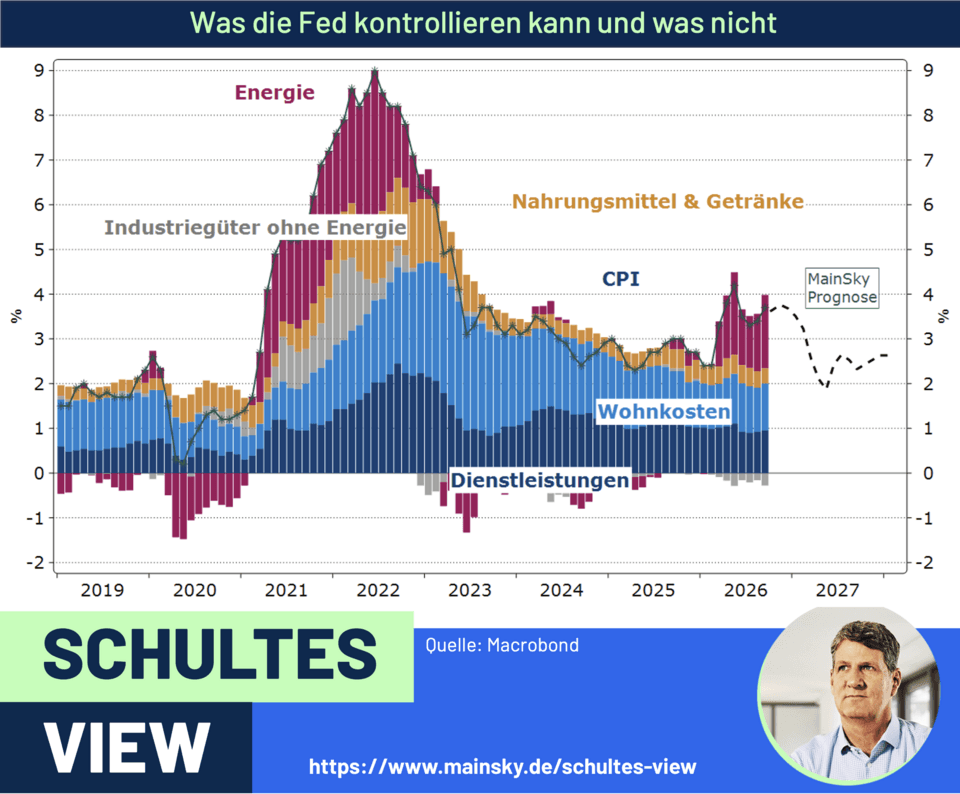
Our MainSky view: A look at the actual drivers reveals a nuanced picture. The supposed “inflation problem” is concentrated in two components that the Fed simply cannot control:
Energy (magenta): The bars show it clearly: after a period of negative contribution, the energy component is currently surging sharply upward again. As is well known, the cause lies in geopolitics – not in US demand. Higher interest rates do not produce oil.
Housing costs (light blue): This block continues to account for the largest and most sluggish part of inflation. It is a purely statistical, lagging effect (OER) that reflects market conditions from 6 to 12 months ago. Real-time rent indices have long been falling.
What the Fed can actually influence gives little cause for concern:
Services (dark blue): The inflation contribution of services stands at one percentage point and has declined significantly since 2022. There is no inflation problem here, which is consistent with the relatively weak position of the US consumer.
Food & beverages (yellow): This wedge has been shrinking steadily for months – momentum is visibly flattening and the inflation contribution is a mere 0.3 percentage points.
Industrial goods excluding energy (gray): The bars already extend below the zero line into negative territory. Here we are seeing genuine deflation!
Conclusion: To force overall inflation down to 2% under these conditions, the Fed would have to push the remaining services component deep into negative territory. In modern history, that has only happened during deep recessions such as 2009 or 2020. It is probably obvious that this is not a real option. This applies all the more since the effects in housing costs will soon fade and those in energy will reverse. Our forecast sees inflation at approx. 2% in mid-2027, and thus at the Fed’s target. We continue to expect a pause in rates in October, but December remains in play as an “insurance move.” That should then be it, however – for 2027 we do not expect any further rate hikes